Scan Quality Control (QC) AI Employee

Product-specific scan quality control for everything your lab makes

Checks every scan against the product in the Rx and routes the case in about 2 minutes. 10–20% of technician time goes back to design.

Who we build for

Dental labsOrthodontic labsAligner companiesSleep appliance labsDSOs

Scan QC AI Employee

There is no such thing as a good scan

A margin that does not matter for a night guard decides whether a crown fits. Generic scan QC in the scanner does not apply product- and lab-specific criteria.
Product-specific scan QC is available for the following products:

  • Crown preps
  • Night guards
  • Splints
  • Sleep apnea appliances
  • Retainers
  • Aligners
  • All ortho appliances
    Next on roadmap
  • Dentures
  • Implant scan bodies

Where the AI Employee gets scans and where the result goes

Your lab portal, via API

Scans
From your lab portal
Result
Back to the same case in your portal
Time
About 2 minutes

Scanner clouds, no API needed

Scans
From iTero, Medit, Shining 3D, DS Core, Dexis and Allied Star
Result
To your customer support team
Time
About 2 minutes

Patient data stays on Google Cloud, under a BAA with Google

Patient data is stored and processed on Google Cloud infrastructure configured to support HIPAA compliance under a Business Associate Agreement (BAA) with Google. AI compute runs in a Google data center in your region.

Member of the Google for Startups Cloud Program · Featured on the Google Cloud Blog →

5 minutes

Onboard the Scan QC AI Employee in 5 minutes

Give the AI Employee access to your scanner clouds and share your QC criteria. That is it. Much faster than hiring and training a new technician.

Book a call to onboard the Scan QC AI Employee

What the AI Employee checks

It measures every defect against product-specific criteria, while dental technicians rely on visual judgment, which can differ from case to case.

Crown prep specific

  • Margin line visibility, measured as the % of the margin that is visible
  • Restorative space, occlusal and interproximal
  • Undercuts, measured by size

Generic criteria

  • File format
  • Two arches or single arch
  • Holes
  • Double images
  • Artifacts
  • Occlusion (hypercontacts and open contacts)
  • Gingival margin
  • Unrecorded areas

Ortho specific

  • Palate (full or horseshoe)

It measures. The lab decides

All thresholds follow the lab's rules. For example: how big an undercut the lab fixes, and when it asks the doctor to retake the scan.

Crown Prep QC

Every crown prep, measured the same way

MovixTech internal study: three senior dental technicians reviewed the same 226 crown preps. They agreed on only 62% of them.

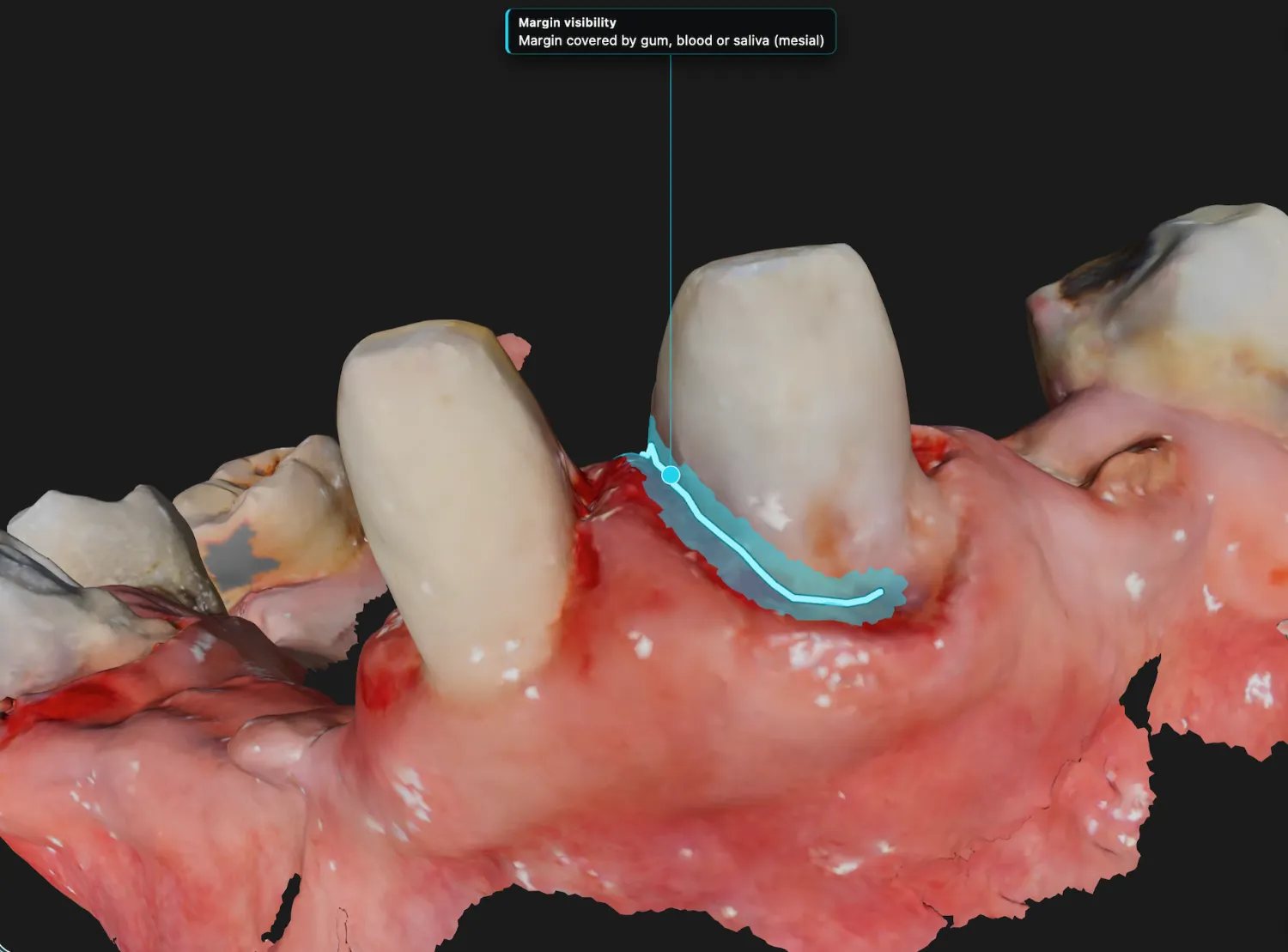
3D scan of tooth 32 with the margin line covered by gum, blood or saliva on the mesial side highlighted by the AI Employee
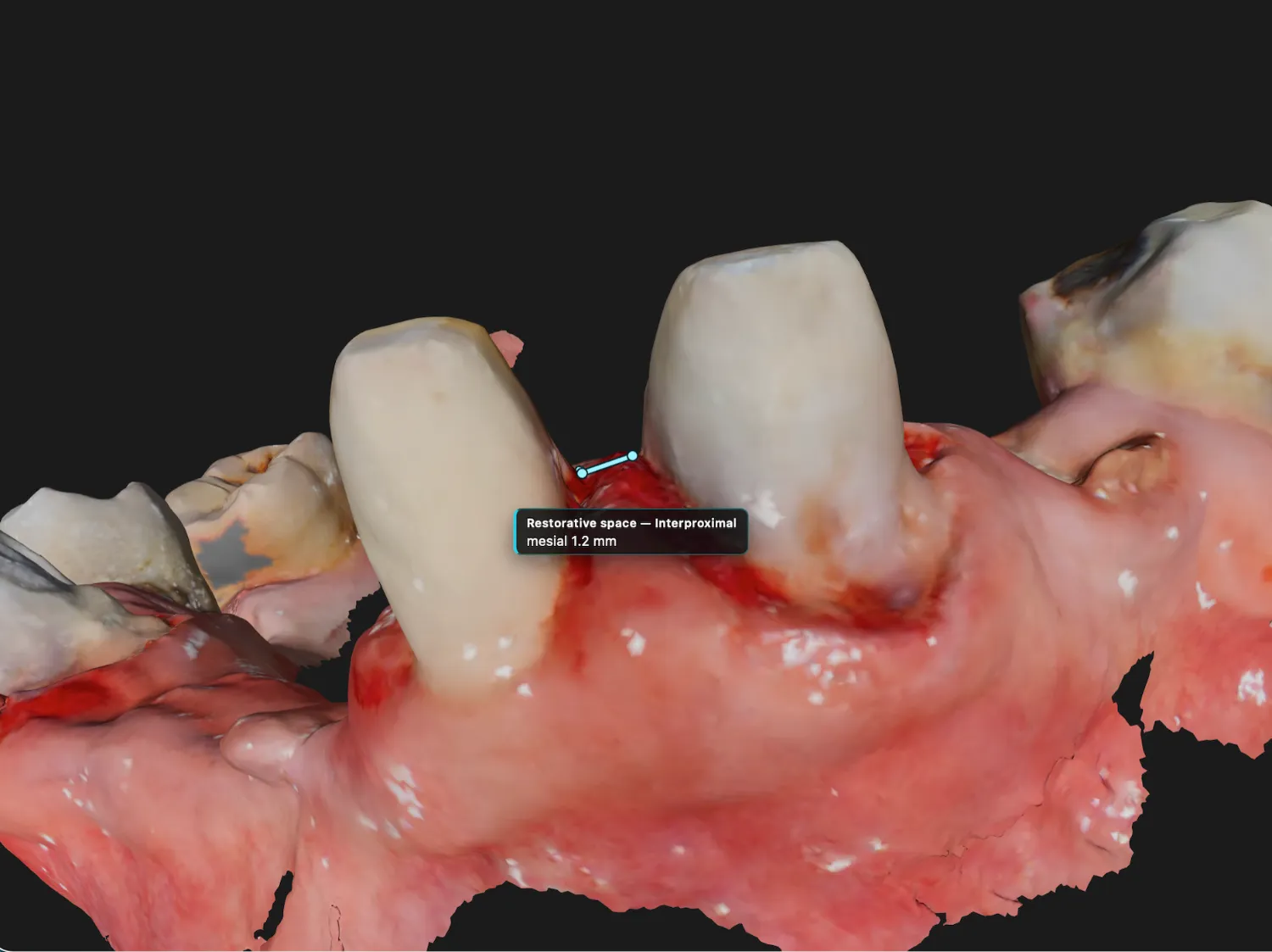
3D scan of tooth 32 with the mesial interproximal restorative space measured at 1.2 mm
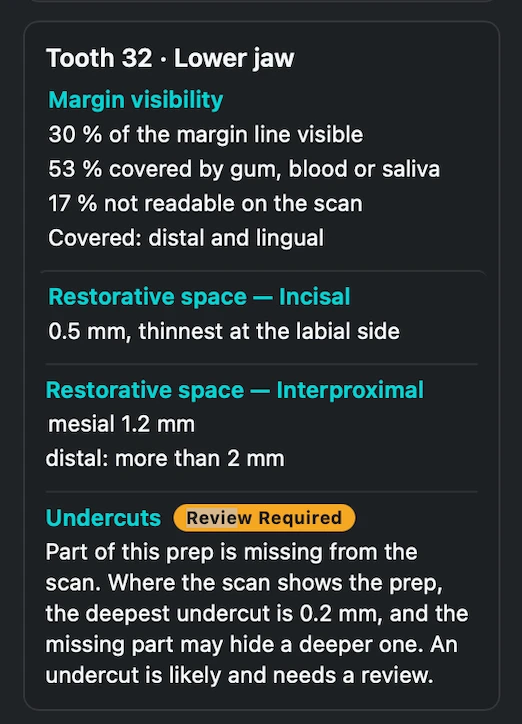
Tooth 32 report: margin visibility, restorative space and undercuts

Crown Prep QC: the Scan QC AI Employee measures the margin line, restorative space and undercuts.

Book a call to onboard the Scan QC AI Employee

Scan QC for night guards, splints, sleep apnea appliances, retainers, aligners and all ortho appliances

Every case ends up in one of three places, automatically

~5%

Doctor rescan required

~25%

Repair required

~70%

Ready for production

Who gets the results?

1

Find and measure the issue

The AI Employee marks the issue on the 3D scan.

2

Send a notification

Customer supportAn explanation and a 3D image of the issue. Customer support calls the doctor, forwards the notification or texts the doctor a link to the 3D image.
DoctorLike an AI dental technician standing behind the doctor’s or dental assistant’s shoulder, checking the crown prep.
3

Get the right rescan while the patient is in the chair

The doctor knows exactly what to rescan, before the patient leaves the office.

Message to the customer support team or doctor

Please note that there’s an unrecorded area on the second molar. This will cause an aligner misfit. Please let me know if you would like to proceed and cut the aligner behind the first molar.

3D scan with an unrecorded area on a second molar highlighted

In production

US-based aligner company, live since November 2025

Dental technicians do not do QC at all. The AI Employee does this work end to end.

2 days

shorter turnaround time

15%

of dental technicians’ time saved

More designs

with the same headcount

Accuracy · orthodontic scan QC

More accurate than a dental technician

Accuracy of 4 generations of our Scan QC AI Employee on orthodontic scans. A dental technician doing QC is 80–85% accurate.

How we tested it on 500 real cases

Step 1

The AI Employee checked 500 orthodontic production cases in a row.

Step 2

Senior dental technicians with 6+ years in QC and scan repair checked the same 500 cases by hand.

Result

~95%

The AI and the technicians reached the same result. 97% of good scans passed, so no unnecessary retakes. False alarms: about 3%.

The numbers

Manual scan QC vs the Scan QC AI Employee

Manual scan QCScan QC AI Employee
Technician time on file handling, prep review and doctor calls10–20%Done by the AI Employee
QC cost per scan~$2.50Calculate your QC cost

The ~$2.50 is based on a $60,000 crown technician who spends 10–15% of their time on QC.

FAQ

Questions labs ask about scan QC

What is product-specific scan QC?

It is scan quality control that checks the scan against the product in the Rx. A margin that does not matter for a night guard decides whether a crown fits. The same scan can pass for one product and fail for another.

Why does the same scan pass for one product and fail for another?

Each product needs different things from the scan. For example, 0.4 mm of occlusal space is a problem when the doctor orders a PFM. A PFM needs 1.2 mm.

Which products does the Scan QC AI Employee check?

Crown preps, night guards, splints, sleep apnea appliances, retainers, aligners and all ortho appliances. Next on the roadmap: dentures and implant scan bodies.

Does it replace the scan check built into the scanner?

No. A scanner check does not apply product- and lab-specific criteria. The AI Employee works alongside it and checks the scan against the requirements for that product.
Who sets the thresholds?

The lab. The AI Employee measures the margin, the space and the undercuts. The lab's rules decide what happens next: fix it in-house or ask the doctor for a rescan.

How accurate is it?

On orthodontic scan QC, the fourth generation of the Scan QC AI Employee is 96% accurate. The accuracy of a dental technician doing QC is 80–85%.

Why is it more accurate than a technician?
  • Our own AI models. General-purpose LLMs have low accuracy on dental scans. We built two foundational AI models for dental scans.
  • Data labeled in-house. Our labeling technicians have 6+ years in digital dentistry on average.
  • 50% of expenses in R&D. About 20 releases in the last 12 months.

Read more: Half of Our Expenses Go Into R&D

Why take scan QC off dental technicians?

Dental technicians generate the lab's revenue. In Lean Six Sigma terms, scan QC is not revenue-generating work. The AI Employee takes QC off the technicians, so their hours go to work that generates revenue.

Does the lab still review cases?

Yes, the exceptions. The AI Employee handles the volume. A person reviews the exceptions, not every case.

Do we need an API or a new LMS?

No. An API with your lab portal is optional. Without it, the AI Employee pulls scans straight from the scanner clouds and sends the result to your customer support team. Your LMS stays the source of truth.

Where is patient data processed?

Patient data is stored and processed on Google Cloud infrastructure configured to support HIPAA compliance under a Business Associate Agreement (BAA) with Google. AI compute runs in a Google data center in your region.

In the clinic, for DSOs

The same AI Employee can stand next to every dentist and assistant

Product-specific scan QC before the patient leaves. The doctor rescans on the spot instead of discovering the problem days later, so the callback never happens.

Your callback rateCallbacks per 1,000 casesCost at ~$250 each
5%50$12,500
10%100$25,000
30%300$75,000

Callback rates run 5–30% across the industry.

Start with one AI Employee. Add the next one when it pays for itself.

Every AI Employee has a job, a cost and a result your lab can measure.