On paper—especially the SOPs you hand to the FDA—your Scan QC process looks clean and measurable.
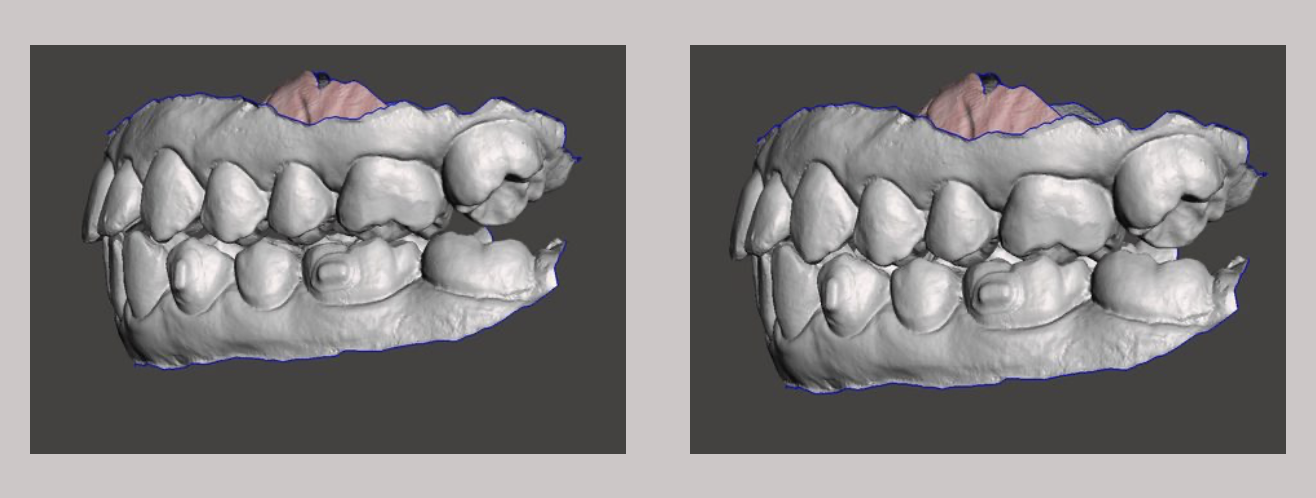
Hole larger than 1.5 mm → Send the scan back to the doctor.
Hypercontacts over 0.5 mm → Send it back.
Look at the picture. Can you tell a 1 mm open contact from a 0.5 mm one?
Neither can your tech.
In real production, nobody measures anything.
Scan QC is a judgment call, and it changes with whoever is on shift.
The same case passes Monday and fails Thursday.
So you have a quality system. You just don't have it running.
Here's why that's not a compliance problem—it's a P&L problem.
Every inconsistent Scan QC call is scrap you pay to redo, turnaround you lose, and labor you burn arguing about. Those are three of the first lines a buyer opens your P&L to. Inconsistent Scan QC quietly drags all three.
A Scan QC Digital Technician runs the SOP you already wrote—the same way, every time.
For a lab doing 5,000 cases per month:
Scan QC labor today
$2.50 × 5,000 = $12,500/month
AI Digital Technician
$5,500/month
Savings
$7,000 every month — about $84,000 per year, on Scan QC alone.
The problem doesn't stay at one lab—it multiplies.
Three labs, three different Scan QC bars. Three teams interpreting the same SOP in three different ways.
A Scan QC Digital Technician gives every site one workflow and one quality standard. Same spec. Same result. Everywhere.
And when you buy the next lab, it plugs into that layer on day one—not after a 12-month integration slog trying to get their techs to match yours.
So that $84,000 per year isn't one number. It's per lab, compounding across every site you own—plus faster turnaround, less scrap, and Scan QC that's auditable instead of anecdotal.
In owner math, an AI operational layer like this is worth roughly 3–4 turns of EBITDA multiple.
Scan QC shouldn't be a debate. It should be measured, consistent, and something a buyer and investor can trust—at every lab you own, and every lab you're about to.
See how a Scan QC Digital Technician works in practice.